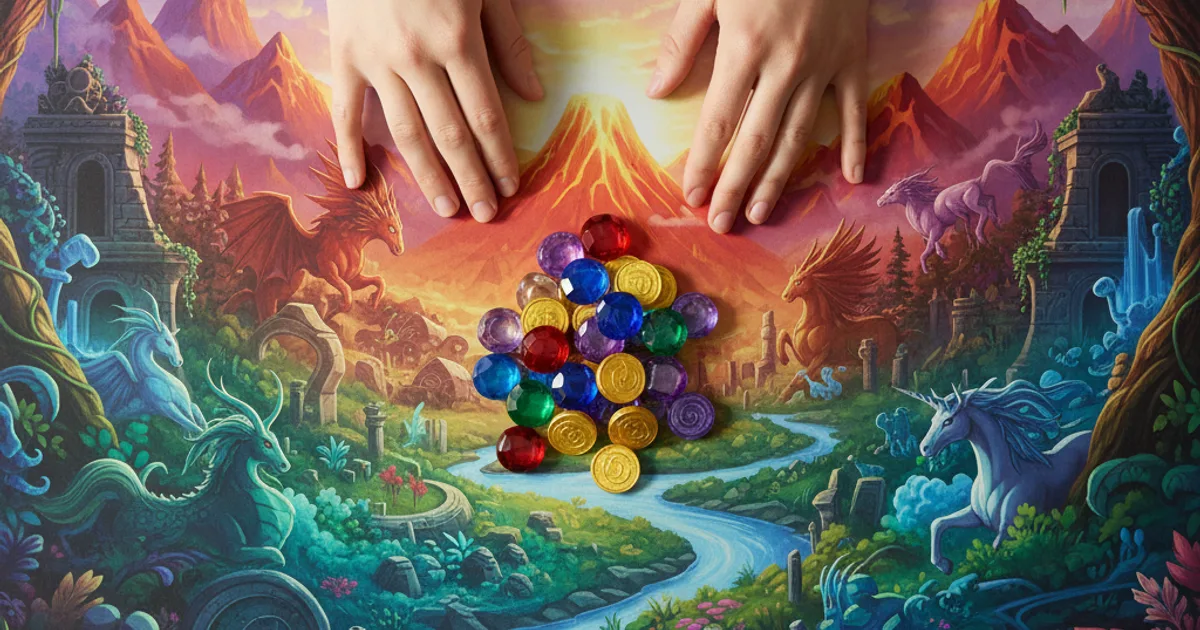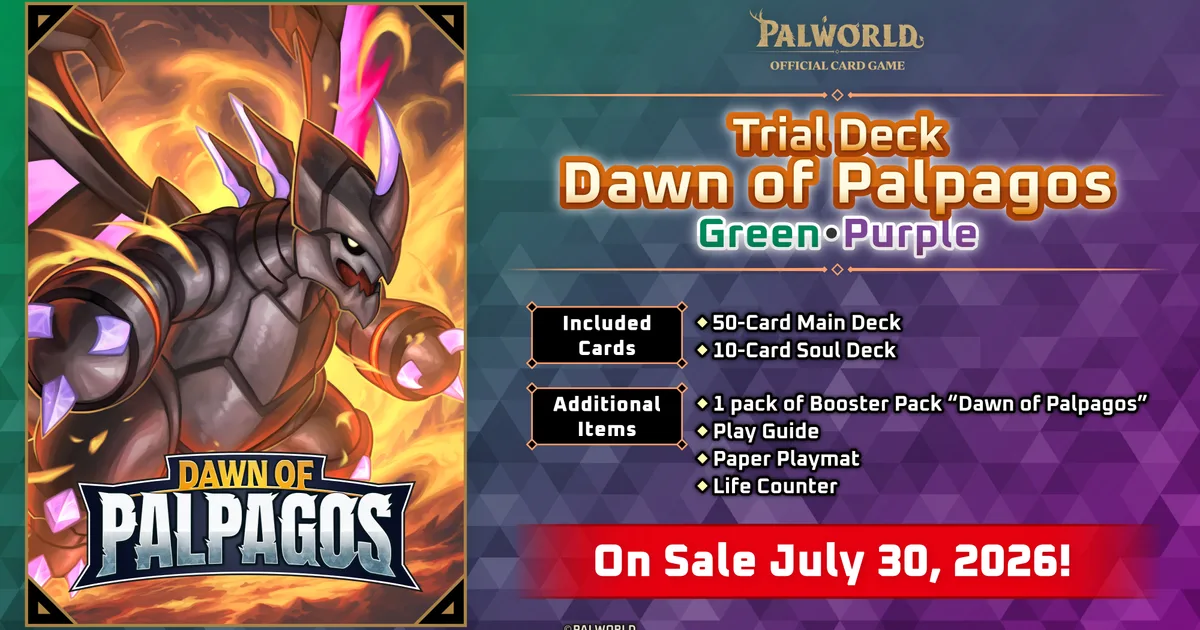

Most card games teach you to hold something back. Keep a land untapped, keep a counterspell live, keep options open. Palworld TCG teaches the opposite, and it teaches it quietly, because the rule that does the teaching is not written down anywhere as a warning. It is just an arithmetic consequence of three sentences in the rulebook.
Here they are. Your souls sit in your soul area. You gain two per turn. Your stand phase stands all of them.
Read those together and a slightly uncomfortable conclusion falls out: you cannot save a soul for later. Not for next turn, anyway. A soul you do not rest this turn does not become an extra soul next turn. It becomes nothing. Next turn's total was already decided before either of you drew a card.
That does not make the "when to spend, when to save" question meaningless. It makes it a different question than the one most players think they are asking. So let us go through the whole system, from what a soul physically is to the handful of cards that bend the schedule, and finish with the one situation where holding a soul back genuinely pays.
What a soul actually is
Start with our own glossary, which defines it in one line: a soul is "What you pay costs with. You gain 2 per turn from your soul deck, and you spend one by resting it; rested souls stand again in your next stand phase."
The word doing the work there is resting. Souls are never discarded, sacrificed or removed. Paying a cost turns a standing soul sideways and leaves it exactly where it was. The Comprehensive Rules say it plainly at 10.4.3: if a cost requires a number of souls, you "change the specified number of souls in your soul area from standing state to resting state." Nothing moves zones. Nothing goes to the graveyard.
Which means the number of souls you have and the number you can still use are two different figures, and a card asking about one is not asking about the other. We will come back to that, because one card in the current pool lives entirely on the distinction.
Two zones hold them, and both are worth knowing by name. The soul deck (4.8) is where your ten start, and it is a public zone, though you are not required to keep the cards face up. The soul area (4.9) is where they go once the game moves them, and it is public too, with orientation tracked. Your opponent is entitled to know how many souls you have and how many you have already spent. Nothing about your economy is hidden.
The souls themselves are as close to blank as a card gets. Of the nine Soul card numbers on the publisher's card list, exactly one prints any text at all, and what it prints is a reminder of a rule that applies to everybody with or without it. Reminder text, as our glossary notes, "is part of the card's text but has no effect on the game." Soul cards are therefore a purely cosmetic choice, which is why our rules page can say that a soul deck "is usually ten copies of one card" without that being a deckbuilding opinion. There is nothing to build.
The schedule, which is printed before you sit down
Deck construction has three limits on the main deck and exactly one on the soul deck: it has ten cards. The rulebook gets there from the other direction, at 6.1.2.1, by fixing the ceiling first. "The upper limit of each player's souls at the beginning of the game is 10." You then prepare that many.
Setup moves nothing for the player going first. The player going second immediately puts one soul into their soul area (6.2.1.5), a small compensation for the seat. After that, every turn's soul phase adds two (7.4.2.1), and when the soul deck has fewer than two left it hands over what remains (7.4.2.2).
So the entire economy of the game, both seats, for as long as it lasts:
| Your turn | 1 | 2 | 3 | 4 | 5 | 6 and after |
|---|---|---|---|---|---|---|
| Going first | 2 | 4 | 6 | 8 | 10 | 10 |
| Going second | 3 | 5 | 7 | 9 | 10 | 10 |
That is it. That is the whole thing. Both players top out at ten on their fifth turn and stay there forever. The player going second is exactly one soul ahead for the first four turns and level from then on.
One soul does not sound like much. Against the shape of the card pool it is worth more than it looks, because costs are whole numbers and a large slice of the pool sits on an odd one. Reading the publisher's card list on 30 August 2026 gives 256 rows and 255 distinct card numbers, which comes down to 148 distinct main-deck-legal cards once you drop parallel printings and the nine promos that reprint an existing card under the same name. Of those 148, sixty-two cost three, five or seven souls. That is 42% of every card in the game, and every one of them lands a full turn earlier from the second seat.
The compensation running the other way is in the draw step, and it is the one place the rulebook leaves a door open. Clause 7.3.1 reads: "The player who goes first skips the draw phase, and proceeds to the soul phase." It does not say that this applies only to the first turn. Our rules page reports the wording as published rather than picking a reading, and this piece will do the same. If you are building around the answer, go to the Comprehensive Rules rather than to us.
Why "banking" is not a thing
Now the arithmetic. On turn three going first you have six souls. Suppose you spend four and leave two standing. On turn four you have eight. Not ten. The two you saved did not go anywhere, they simply stood back up alongside the two the soul phase added, and the total is what the schedule always said it would be.
Souls do not accumulate. They refresh. The pool is not a bank account, it is a water level.
Which turns "should I save souls for a big turn later?" into a question with a flat answer: there is no later to save them for. If a card costs eight and you have six, you are not two souls short because you overspent last turn. You are two souls short because it is turn three. Nothing you did or did not do with turns one and two changes the number in front of you.
The practical version of this is blunt and worth saying once, plainly: on your own turn, an unrested soul is a wasted soul. If you finish your main phase with three souls standing and nothing you wanted to do with them, that is three souls of your fixed lifetime budget that produced nothing. Over a five-turn game the first seat gets thirty soul-rests in total and the second gets thirty-four. Leaving three on the table is a tenth of the game.
That is also why the pool's cost curve is shaped the way it is. Three cards cost one soul, 33 cost two and 31 cost three. Line those up against the schedule and the first turn of the game is unusually lopsided: the player going first has two souls and 36 of the pool's 148 cards to choose from, while the player going second has three souls and 67. Nearly double the menu, on the strength of one soul. The game very much wants you to have something to do with the small numbers, because the small numbers are all you get for a while.
The one thing saving is for
There is exactly one situation in which leaving a soul standing is correct, and it is not on your turn at all. It is on your opponent's.
Look again at 7.2.1: "The turn player stands all of the cards in their base and soul area." The turn player. Your souls stand in your stand phase, and only in yours. So the orientation you leave them in at the end of your turn is the orientation they keep for the whole of your opponent's turn.
And there is a keyword that spends a soul on your opponent's turn. From our rules page, Interrupt is "A quick ability that nullifies your opponent's attack, paid for by discarding this card — with a soul, or with another card from hand." The printed cost on the cards themselves is more precise, and the choice it offers is the whole point:
[①, discard this card] OR [Discard this card and 1 other card from hand] Nullify the opponent's attack. Battle damage does not occur.
One soul plus the card, or two cards and no soul. Ten cards in the current pool carry it, from Foxparks – A Toasty Hug (ETD01-004) at four souls up to Blazehowl – Hellflame Defender (EBP01-014) at seven, and every one of them prints that identical pair of costs.
This is the real "when to save" decision in Palworld TCG, and it is a small, concrete one rather than a grand strategic posture. It reads: if I hold an Interrupt and I expect to want it, is the last soul of my turn worth more than the second card I would otherwise have to pitch? Leave one standing and the Interrupt costs you one card. Tap out completely and the same Interrupt costs you two.
Note the direction that runs. You are not saving souls to do something bigger later. You are saving one soul to make a card in your hand cheaper, tonight, on somebody else's turn. That is the entire scope of saving in this game.
What "increase your soul" does, and does not do
Six main-deck cards in the pool print the word soul in their text, and all six are Green. That is not a coincidence anyone has to guess at; it is simply where the designers put the economy.
Three of them ramp: Dumud – Mellow Bounty (EBP01-057), Feed Box (EBP01-065) and Lily's Strategy (EBP01-070) each say some version of "Increase your soul by 1 card in the rest state."
The publisher's own Q&A settles both questions that phrase raises. Asked what "increase soul" means, the answer is: "It means placing the specified number of souls from the Soul Deck into the Soul Area." Asked whether it can take you past ten, the answer is: "No, you cannot. The maximum limit for souls is 10, so you cannot increase them beyond that number." Both entries are published on the official Rule/Q&A pages against these exact card numbers.
Two things follow, and neither is what the word "ramp" usually promises.
First, this is acceleration, not creation. Every soul you gain this way comes out of the same ten-card soul deck you were going to draw from anyway. You are pulling the schedule forward, not raising the ceiling. One ramp puts you a single soul ahead of the table above, and then the table catches up at ten and you are level with everybody else for the rest of the game. Ramp here comes with an expiry date printed on it.
Second, read "in the rest state" carefully. The soul arrives already spent. It does nothing this turn. It stands up in your next stand phase like everything else, which means a three-soul Lily's Strategy that ramps has cost you three souls now to have one more soul next turn, and then never again. As a mode on a card that also has two combat modes, that is fine. As a plan, it is not one.
Dumud is the one that earns it, because it charges you nothing extra. Its trigger reads: "When this card is assigned to a 「Farming」 structure, increase your soul by 1 card in the rest state." The pool contains exactly two Farming structures, Ranch (EBP01-066) at two souls and Breeding Farm (EBP01-063) at three, and Dumud itself carries the Farming suitability those structures ask for. Assign Dumud to Ranch and you are paying Ranch's cost anyway; Ranch gives you three Material or three Ingredient and a card, and Dumud's trigger adds the soul on top for free. At 500 Power, Dumud was never going to be doing anything better with its turn.
Assigning is not free in the abstract, mind you. Our rules page puts the trade in one sentence: "Assigning rests a standing Pal", and an assigned Pal "is not available to attack or block until it stands again." Board presence now, or the structure's output instead. That trade is the same one the whole soul system keeps asking you to make.
Standing souls back up, which is the acceleration that actually works
If you cannot raise the ceiling and you cannot bank the surplus, the only way to get more out of a turn is to rest the same soul twice. Three cards let you.
Petallia – Sweet Blessings (EBP01-051) is the simplest: six souls, and on deploy you "Gain 1 life, choose 2 souls, and stand them." Net cost four, plus a life, plus a 700-Power body. The refund arrives the moment it lands, which is the useful part: deploy it late in a turn you would otherwise have tapped out on, and one of those two souls can stay upright for an Interrupt.
Cola Vending Machine (EBP01-064) is the engine version, at six souls with an ability costing X Ingredient and an assigned Pal: "Choose 1 soul, and stand it. Then, choose up to 3 times of X number of souls, and stand them."
And then there is Feed Box, which is the most interesting card in this entire discussion and costs two souls.
Its ability reads: "[Consume 1 Ingredient] Increase your soul by 1 card in the rest state. If there were 10 or more souls before increasing, choose 2 souls, and stand them."
Since ten is the ceiling, "10 or more" can only ever mean exactly ten, and at exactly ten your soul deck is empty, so the increase finds nothing to move and does nothing at all. Rule 1.3.2 covers that outcome: "If anything attempts to make a player do something he or she cannot perform, then nothing happens."
Which means Feed Box quietly changes jobs on the turn you hit ten souls. Early on it is a slow ramp card. From ten onward it is a repeatable "pay one Ingredient, stand two souls", once per turn, for the rest of the game, off a two-cost structure. Same card, same text, completely different function, and the switch is thrown by a number the schedule guarantees you will reach by turn five.
Four places the arithmetic bites
You cannot deploy Jormuntide Ignis and stand it in the same turn on souls alone. Jormuntide Ignis – Savage Lava Dragon (EBP01-001) costs eight and its ability is "[③] OR [Discard 2 cards from hand] Stand this card." Eight plus three is eleven, and eleven is more souls than the game will ever give you in one turn. That is not a subtle interaction, and it is a good reason for the card to offer an alternative cost paid in cards. Deploy it, attack, then discard two to attack again.
Unless, of course, you have a Feed Box and an Ingredient. Ten souls: deploy for eight, attack, spend the Ingredient to stand two, and you are at four standing with three to pay. The line exists, it just needs a second card and a resource on the board first. Worth knowing before you decide the Dragon is uncastable.
Digtoise's condition does not care whether your souls are upright. Digtoise – Seismic Drillback (EBP01-050) carries "If you have 10 or more souls, this card gets Power+1000/Strike+1." A soul you rest to pay a cost stays in the soul area (10.4.3); resting changes its orientation, not its zone. The rulebook keeps the two quantities visibly separate when it explains playing without physical soul cards at 13.2.2, where a player tracks "the total number of soul cards that would be placed there" and "the number of those soul cards that would be in the standing state." On that reading, Digtoise switches on when you reach ten and stays on for the rest of the game no matter how hard you tap out. We should say plainly that this is a reading of the clauses rather than a published ruling. No Q&A entry addresses it, and by 1.3.1 the card's own text wins if it ever contradicts the rulebook.
The three-soul draw is not "playing a card". Every deck has it, and our rules page lists it among the actions available in your main phase: pay three souls to draw a card, once per turn. The rulebook files it at 8.5.1 and 8.5.2. The official Q&A was asked whether it counts as playing a card and answered "No, it does not." That matters for one card in the pool. The Adventure Begins (EBP01-100) costs two and draws you two cards "If you have not played any other cards during this game". The ruling means the soul draw costs you nothing in that condition: you can take it and still cast the Event with its bonus live. Going second, on a turn two that followed a turn one you passed on, five souls is exactly enough to do both. Rest three to draw one, then pay two to draw two more. Three cards out of a turn you had already written off.
The soul draw is a floor, not a plan. Three souls is a lot when you have six and it is nothing when you have ten. Before turn five, converting half your economy into one card is a real cost and usually the wrong one. From turn five, when you are permanently at ten and your curve has run out of things to add, it is the outlet that stops the schedule going to waste. If you find yourself regularly ending turns with three unrested souls and no draw taken, that is not a hand problem. That is free cards you declined.
Where you can save: the resources
Here is the part that reframes everything above. Palworld TCG does have a resource you can bank. It just is not souls.
Material and Ingredient are the game's two resources (3.3.1.2.1), and the rulebook gives them the opposite properties. They are public information, like souls (3.3.4). But the only limit on them is a floor: "The number of resources owned has to be 0 or more" (3.3.3). No ceiling. No refresh. No reset at end of turn. What you do not spend, you keep.
That is the actual answer to "when should I save for a big play". You save in Ingredient, in Material, and in cards in hand. Souls are the thing that expires.
It also explains why the Green package hangs together the way it does. Primitive Furnace (EBP01-016) converts stored Material into a cheaper Gear. Feed Box converts stored Ingredient into standing souls. Cola Vending Machine converts a lot of stored Ingredient into a lot of standing souls. The engines all point the same way: bank the thing that keeps, then spend it to get a second use out of the thing that does not.
Cost reduction, meanwhile, barely exists. Two cards in 148 reduce what you pay, Primitive Furnace for your next Gear and Elizabee – Queen of the Flower Garden (EBP01-053) for a Beegarde off the top of your deck, and both print the same limiter: "It does not become ◇0 or less from this ability." The schedule is not something the card pool is currently interested in letting you cheat.
The short version
Nine things worth carrying to a table.
- Your economy is 2, 4, 6, 8, 10 going first and 3, 5, 7, 9, 10 going second, and nothing you do changes it.
- An unrested soul on your own turn is a wasted soul. Plan turns to spend the whole number.
- The exception is one soul left standing for an Interrupt. It is standing through your opponent's turn, and it saves you a card.
- Going second is a turn faster on every odd cost, which is 42% of the pool.
- Ramp brings the schedule forward, it does not raise the ceiling, and it arrives rested.
- From turn five, Feed Box stops being a ramp card and becomes a soul refresh.
- Standing souls back up is the only real way to get more out of a single turn.
- Once you are parked at ten, take the three-soul draw on any turn you cannot spend the difference.
- Save Ingredient. Save Material. Save cards. Do not save souls.
How we checked this
Everything above comes from four places, and none of them is a community wiki.
The rules are the Palworld OFFICIAL CARD GAME Comprehensive Rules ver. 1.00, dated 30 July 2026, read directly from the publisher's PDF. Clause numbers are quoted so you can check any of it in a minute. Our own rules page and glossary are that document in plain English, and where this piece quotes a keyword it quotes their wording rather than paraphrasing.
The two rulings on "increase your soul" and the one on the three-soul draw come from the publisher's Rule/Q&A, which held 97 entries when we read it on 30 August 2026. Three of those mention souls, and all three are quoted here in full.
Card text, costs and the pool figures come from the publisher's card list read the same day: 256 rows, 255 distinct card numbers, reducing to 148 distinct main-deck-legal cards and 91 Pals once parallel printings and the nine promo reprints are folded into their originals. That 148 is the denominator behind every percentage in this article. Card links go to our own catalogue.
Two things you will not find above, deliberately. There are no win rates, because the game has not published any tournament results yet and a popularity count is not a result. And there are no play percentages, because this is a piece about a system rather than a metagame, and it should still be correct after the next set lands. The only figures here that a new set will move are the pool counts, and those are stated with the date they were read.