Here is the strange thing about the Red・Blue trial deck. The cards that look expensive are the ones nobody plays. The 1600-Power monster with four Strike and a keyword no other card in the game has? Five per cent of decks. The eight-cost Lucky Pal that throws 1000 damage the moment it lands? Seven and a half.
Meanwhile four of its cheap, plain-looking cards sit in the top eleven most-built cards in the entire Palworld TCG, one of them second only to Strike from the Darkness. A four-cost Pal from this box is in three of every four Red decks in existence, and five of every six players who run it run four copies.
So this is not a review that ends "good starter, buy one". It is a box with its reputation upside down, and it is worth going through card by card to see why.
What is actually in the box
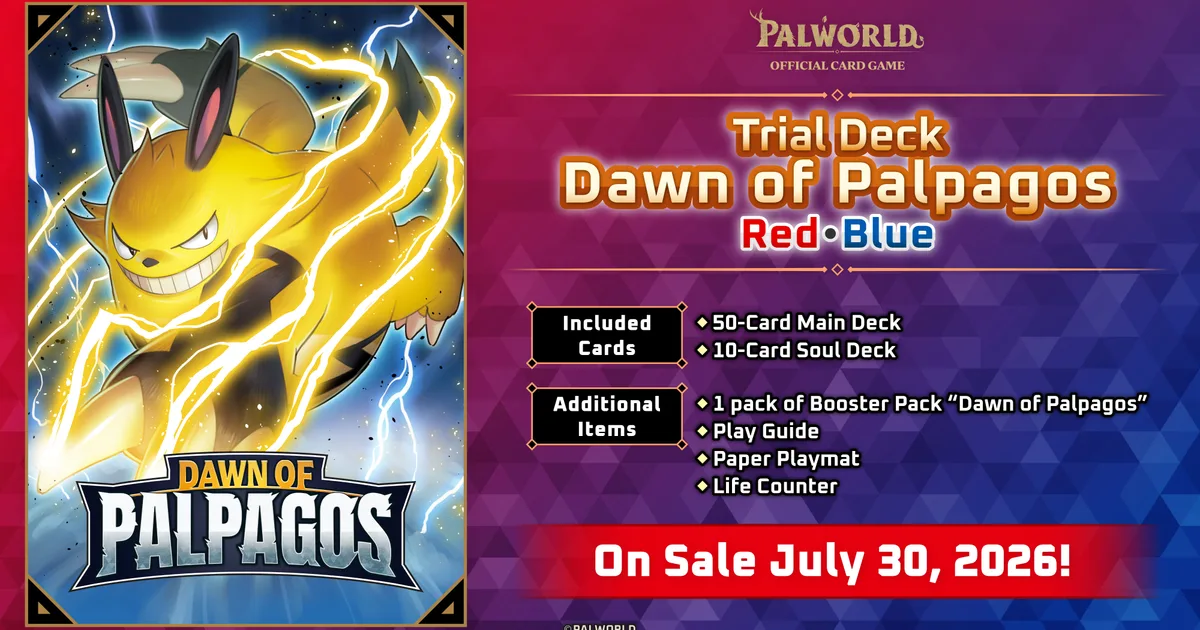
The publisher's product page lists a 60-card set (50 main deck, 10 soul deck), a paper playmat and play guide, a life counter, a material and ingredient counter, and one sealed pack of Booster Pack Dawn of Palpagos. One card in the main deck is replaced by a parallel printing, either a Trial Deck Super Rare (TSR) or a Trial Deck Super Parallel (TSP). Released 30 July 2026, the same day as everything else in the game.
What the product page does not print is the decklist. So here it is, from our own catalogue entry for the deck, which the platform ingested from the physical product and which checks out card-for-card against the publisher's card list:
| Copies | Card | Number | Cost |
|---|---|---|---|
| 2 | Stone Pit | ETD01-008 | 1 |
| 2 | Antique Wooden Chair | ETD01-019 | 2 |
| 2 | Crystal Breath | ETD01-022 | 2 |
| 2 | Ignis Breath | ETD01-011 | 2 |
| 3 | Jolthog Cryst – Stoic Yet Innocent | ETD01-013 | 2 |
| 2 | Jolthog – Shocking Yet Innocent | ETD01-002 | 2 |
| 2 | Lamball – My First Pal | ETD01-023 | 2 |
| 2 | Ribbuny – Little Princess | ETD01-024 | 2 |
| 2 | Kelpsea Ignis – Balmy Magma | ETD01-003 | 3 |
| 2 | Pengullet – Frequent Flyer | ETD01-014 | 3 |
| 2 | Primitive Workbench | ETD01-020 | 3 |
| 2 | Single-Shot Sphere Launcher | ETD01-021 | 3 |
| 2 | Weapon Workbench | ETD01-009 | 3 |
| 2 | Foxparks – A Toasty Hug | ETD01-004 | 4 |
| 2 | Hangyu Cryst – Frigid Wanderer | ETD01-015 | 4 |
| 2 | Single-Shot Rifle | ETD01-010 | 4 |
| 3 | Arsox – Burning Spoils | ETD01-005 | 5 |
| 2 | Reindrix – Icy Gaze | ETD01-016 | 5 |
| 2 | Elphidran Aqua – Gentle Ripples | ETD01-012 | 6 |
| 2 | Mossanda Lux – Vanguard Captain | ETD01-006 | 6 |
| 2 | ★ Grizzbolt – Rumbling Tank | ETD01-001 | 7 |
| 2 | ★ Suzaku Aqua – Way of the Current | ETD01-017 | 7 |
| 2 | ★ Blazamut – Molten Sovereign | ETD01-007 | 8 |
| 2 | ★ Mammorest Cryst – Roar of the Tundra | ETD01-018 | 8 |
★ = Lucky Pal. Soul deck: 10 × Soul (ESOUL-001).
That is 34 Pals, eight Structures, four Events and four Gear. Twenty-three Red cards, 23 Blue, four Colorless, and exactly eight Lucky Pals, the legal maximum. Only Jolthog Cryst and Arsox come three to a box; everything else is a pair, so nothing here is a one-of you cannot build around.
Two numbers are worth holding onto. Fifteen of the 50 cards cost two souls, which makes for a very fast opening hand. And eight Structures, against six in the Green・Purple box, is the thread that ties this deck's odder cards together.
How we judged this
Two separate things, kept separate on purpose.
The judgements are read off card text and the rest of the legal pool. When this piece says a card is strong or weak, the argument is what the card does against what else you could play at that cost in that colour. Card text and legality come from the publisher's own card list; rules terms come from our rules page and glossary. The pool at the time of writing is BP01 Dawn of Palpagos, both trial decks and the 2026 PR promos: 148 playable main-deck cards, of which 91 are Pals.
The play rates are a popularity count and nothing more. They come from 1,166 complete public decklists (main deck exactly 50, soul deck exactly 10) on the community deck builder at palworldtcg.gg, pulled on 17 August 2026 out of 1,191 public decks in total. That is what people are choosing to build. It is not a win rate and it is not field share, because neither exists yet: the publisher's Deck Recipe page still prints "No entries found" under both Featured Decks and Tournament Decks, and shop tournaments only started this month. Where a play rate appears below, it sits beside an argument rather than being one.
For scale: 845 of those 1,166 decks contain at least one card from this box, and Blue/Red is the most common colour identity in the sample at 302 decks, ahead of Blue/Purple at 202 and Green/Purple at 180. Where a card is judged "in colour", that means against the 688 decks playing Blue or the 493 playing Red, not against all 1,166.
The four that made the format
Foxparks – A Toasty Hug (ETD01-004). Interrupt is the mechanic that quietly decides games in this format: from your hand, during your opponent's attack, discard this card and pay a soul, and the attack is nullified with no battle damage at all. There are nine Interrupt Pals in the pool, two of them reprinted again as 2026 promos. Foxparks is the joint cheapest at four cost, tied with Dinossom – Radiant Fragrance (ETD02-004) in the other trial deck, and the two are identical down to the stat line of 400 Power and 2 Strike. Red's next cheapest is Bushi – Ephemeral Blade (EBP01-004) at five, which is a Lucky Pal and therefore competes for a capped slot.
It shows. Foxparks is in 369 of 1,166 lists, 74.8% of every Red deck in the sample, and 306 of those 369 run the full four copies. That is 82.9% of the players who touch it going straight to a playset, a rate no other card in a hundred lists or more quite matches (Chillet – Dragon Whisperer, EBP01-025, is next at 82.8%). When a Red deck wants an answer that costs neither a Lucky slot nor a turn, this is the whole list of options.
Reindrix – Icy Gaze (ETD01-016). The same card in Blue, one soul dearer, and the second most-built main-deck card in the entire game: 389 lists, 33.4%, behind only Strike from the Darkness. Blue's alternative is Cryolinx – Arctic Ordeal (EBP01-038) at six, a better body at 900 Power and in 325 lists itself. Plenty of decks simply run both. Reindrix is in 56.5% of Blue decks and 69% of those play four.
Single-Shot Rifle (ETD01-010). Four souls. On deploy, choose up to one Pal and deal 1500 damage. Then it stays on the table and rests to give a Pal +200 Power whenever you like.
1500 is not a number this game hands out. It kills 83 of the 91 Pals in the legal pool outright, and the eight survivors are all eight-cost cards bar one, which is in this box. Axel's Strategy (EBP01-023) matches the figure for the same four souls, but it is an Event that resolves and goes to the graveyard. Kitsun – Wyrmbane Fangs (EBP01-007) deals 1200 for five and only at ◇7 or greater. Makeshift Handgun (EBP01-021) is the same Gear frame at two cost for 500. The Rifle is in 343 lists, 69.6% of Red decks, and it is why Red decks get called gun decks at all.
Elphidran Aqua – Gentle Ripples (ETD01-012). Six souls, 900 Power, and on deploy draw two cards then put one from your hand back on top of your deck. Not a card-advantage engine so much as a selection engine, with a body attached. In 306 lists, 44.5% of Blue decks, 68% of those at four copies. Azurobe – Water Dragon Waltz (EBP01-029) is the bigger six-drop at 1200 Power with a draw and a rest, but it is Lucky, and the eight-card Lucky cap is the tightest budget in deckbuilding. Elphidran Aqua asks for nothing.
Four cards, four places in the game's top eleven, and not one of them is the card on the box.
The best card nobody plays
Grizzbolt – Rumbling Tank (ETD01-001) is seven souls for 1600 Power and 4 Strike, with Assault.
Take those in order. 1600 Power is the most of any seven-cost Pal in the game, and more than five of the twelve eight-drops manage. Four Strike is shared by exactly three Pals in the pool, and the other two, Jormuntide Ignis (EBP01-001) and Mammorest (ETD02-007), both cost eight. Assault is the rarest keyword going: one other card grants it, Gumoss – Curious Sprout (EBP01-058), and only to itself for a turn. It also matters more than it reads. Normally you may attack your opponent, their resting Pals or their Structures, and a standing Pal is not a legal target. Standing Pals are precisely the ones that can block. Grizzbolt just attacks the blocker.
It is in 58 of 1,166 decks. Five per cent. Twelve per cent of those play four.
There is a decent case on the other side, and it is readable off the cards. Every Grizzbolt is one of your eight Lucky Pals, and Red's competition at that cost is Suzaku – Hellfire Wings (EBP01-002), which adds +200 to every non-battle damage effect your red cards produce. In a deck holding a 1500-damage Rifle, a 1000-damage Blazamut, Ignis Breath, the Weapon Workbench and a Pump-Action Shotgun, Suzaku multiplies five things at once while Grizzbolt is one very large Pal. At eight, Jormuntide Ignis (in 20% of all lists) stands itself back up and attacks twice.
That is a real argument. It is not obviously a complete one, and with no results published anywhere, nobody can currently say the field has this right.
Eight Structures, and the card that wants them
Green・Purple is a Pal deck with support. Red・Blue is closer to a Structure deck that happens to have Pals in it, and one card makes the case explicitly.
Mammorest Cryst – Roar of the Tundra (ETD01-018) is an eight-cost Lucky Pal at 1700 Power and 3 Strike, and it gets +200 Power for each of your Structures. Three Structures on the table makes it a 2300-Power Pal, larger than Mammorest – Roar of the Wilds (ETD02-007), the biggest printed body in the game. Its second ability, discard a Structure from hand for +1 Strike, turns the dead fourth copy into damage. It is in 73 lists, 6.3%.
The Structures it counts are a mixed bag.
Stone Pit (ETD01-008) is the engine: one soul, and once per turn you rest a standing Pal to get three Material and draw a card. Repeatable card draw for one soul is exactly as good as it sounds, and the official Q&A confirms once-per-turn is tracked per card rather than per name, so two Stone Pits means two draws a turn. The catch is competition rather than quality. Primitive Furnace (EBP01-016) costs one more soul, does the identical thing, carries 200 more durability, and throws in a second ability that reduces what your next card costs. Stone Pit is in 84 lists to the Furnace's 184, and inside Blue/Red decks the gap is 15.6% to 40.4%.
Antique Wooden Chair (ETD01-019) is the sneaky one. Two souls, 1200 durability, the toughest two-cost Structure in the game, and on deploy it gives a Pal +1000 Power for the turn. That is a combat trick that leaves a permanent behind, at a cost where Blue's alternative, Sphere Workbench (EBP01-043), does nothing the turn it lands. It is also one of only four cards in the pool with 《Antique》 in its name, which is the count Antique Curtain (EBP01-039) uses to decide how many Pals it bounces. Neither is popular, the Chair in 72 lists and the Curtain in 67, so that is a promise rather than an archetype.
Weapon Workbench (ETD01-009) deserves better than 82 lists. Three souls; once per turn, consume one Material and assign a Pal to deal 800 damage to any Pal and give all of your Pals +1 Strike until end of turn. Only three cards in the pool pump your whole board's Strike at all, and the other two are Ragnahawk – Emberwing Striker (EBP01-010), which has to attack to do it and only helps red Pals, and The Adventure Begins (EBP01-100), a one-shot Event with a condition attached. The Workbench's problem is the assign cost: a rested Pal cannot attack, so the buff arrives one attacker short. Only 11% of the decks that run it run four, which reads like people finding the ceiling.
Primitive Workbench (ETD01-020) is the weakest of the four, on arithmetic. Assign a Pal, reveal the top card, deploy it free if it is a ◇6 or less Structure or Gear, otherwise put it in hand. Exactly 12 of the deck's 50 cards qualify, so three times in four it is a slow three-cost cantrip, which is what Stone Pit does for one. In 40 lists.
Two cheap Events, two very different jobs
Crystal Breath (ETD01-022) is two souls, Quick: one Pal gets −3 Strike until end of turn and does not stand during your opponent's next stand phase. Strike is the damage a Pal deals to a player, and only three Pals in the pool have more than 3 of it. So against essentially any attacker this reads "your swing does nothing to my face, and you are tapped out next turn too". Against an attack aimed at one of your Pals it does nothing at all, which is the honest limit. In 139 lists, only 23% of them at four, a sideboard card in a game without sideboards.
Ignis Breath (ETD01-011) is the Red version: two souls, Quick, 500 damage. That covers the game's two-drops and most three-drops and nothing above, which is why it sits in 75 lists. With Suzaku – Hellfire Wings out it becomes 700, and that is a real line rather than a theoretical one.
The blanks, and the three that just miss
Thirteen Pals in the whole pool have no card text at all, and four are in this box, the same tax Green・Purple pays. Jolthog (ETD01-002) and Jolthog Cryst (ETD01-013) are two cost, 300 Power; Kelpsea Ignis (ETD01-003) and Pengullet (ETD01-014) are three cost, 500. Pengullet is the one that survived contact with the format, in 155 lists, largely because Blue has a Pengullet theme running through the booster (Pengullet – Yearning for the Sky, EBP01-028, is in 284) and a body with the right name is worth something even when the text box is empty. Jolthog Cryst, the deck's other three-of, is in 26 lists, 2.2%, the least-played card in the set.
Three more are not blank but miss anyway. Mossanda Lux – Vanguard Captain (ETD01-006), six souls and 1100 Power, consumes two Material to pump itself +500 for a turn; it is in 34 lists and exactly two of those play four. Six is busy in Red, with Ragnahawk pumping the whole team and Pyrin – Cinder Steed (EBP01-013) offering a 1200 body. Arsox – Burning Spoils (ETD01-005), one of the two three-ofs, pays five souls for 800 Power and two Material, and only two cards in this box spend Material at all: the Weapon Workbench and Mossanda Lux. In 54 lists. Hangyu Cryst – Frigid Wanderer (ETD01-015) rests a ◇3 or less Pal on deploy for four souls, and against a format whose best two-drops mostly want to sit still that is close to no effect. 31 lists.
The errata is in this box
The Palworld TCG has produced exactly one errata since launch, and Red・Blue owners are the ones it lands on.
On 31 July, the day after release, the publisher corrected ETD01-024TSR, the parallel printing of Ribbuny – Little Princess: the Strike frame was the wrong colour and the Strike text was missing entirely. The card is fully legal at every level of play, sanctioned tournaments included, and plays as though the correct Strike text were there, which from the base printing is 1.
That only bites if the parallel in your box happens to be that one, and it is worth knowing precisely because the card looks broken rather than misprinted. Cards affected by significant errata may be eligible for exchange; the publisher's page is where to check, not here. The base printing ETD01-024 is untouched, and nothing else in the game has been corrected.
Four rulings that will catch you
All four come from the publisher's official Q&A published on 30 July, and all four come up in games played with this deck out of the box. Fifteen of the 97 entries name an ETD01 card.
- Interrupt only works from your hand. A Foxparks or Reindrix already deployed to your base cannot nullify anything. They are a body or an answer, never both, and you commit when you play them.
- "When this card is put into the graveyard" only triggers from the base. Ribbuny discarded from hand to pay for an Interrupt gives you nothing. Ribbuny turned over off the top of your deck as damage gives you nothing.
- Once per turn is per card, not per name. Two Stone Pits is two draws a turn. Two Weapon Workbenches, two Primitive Workbenches, same.
- Quick cards only fight on your opponent's turn. Crystal Breath and Ignis Breath can be played in your own main phase, but not during a battle you started. The quick step belongs to the defender.
One thing the Q&A does not settle is Lamball – My First Pal (ETD01-023), whose text reads "this card cannot be attacked by ◇4 or greater Pals". A separate ruling establishes that blocking is not the same event as being attacked: an ability that triggers "when this card is attacked" does not fire when you use that card to block. Read across, that suggests a ◇4 attacker blocked by Lamball is fine, because it never attacked Lamball. No published ruling names the card, so treat that as a reading rather than an answer, and ask your judge.
What to change first
If you have this box and a booster pack's worth of ambition, the Blue/Red lists in the sample converge hard, and mostly on keeping what you already own. Inside those 302 decks, this box's Foxparks appears in 243, the Single-Shot Rifle in 221, Reindrix in 167 and Elphidran Aqua in 134. What they add on top is Pump-Action Shotgun (EBP01-020) in 227, Jormuntide Ignis in 179, Pal Sphere (EBP01-047) in 175, Chillet – Dragon Whisperer in 142 and Axel's Strategy in 135.
Read against card text rather than counts, the shape is the same. The cards doing the least work are the four blanks, Mossanda Lux, Hangyu Cryst and one Arsox, and Red and Blue's booster cards at those exact costs all do more. The cards worth taking to four copies are the ones the box gives you two of, which is most of what makes it good: Foxparks, Reindrix, the Rifle, Elphidran Aqua and Stone Pit. That is the unglamorous reason people end up owning two of these.
The one upgrade the counts will not spell out is Primitive Furnace, a strictly better Stone Pit for one more soul, already in 40% of Blue/Red lists, and the cheapest single you can buy to make the deck's engine work harder.
The verdict
As a first purchase this is the better of the two trial decks, for an odd reason: almost none of its value is in the cards on the box art.
What you are buying is the cheapest Interrupt in Red, the cheapest in Blue bar one, the most efficient removal in the game at four souls, and a card-selection engine that does not cost you a Lucky slot. Four cards in the game's top eleven, every one of them a two-of you will immediately want four of. Around them sits a genuinely playable 50, with a fast two-cost curve, eight Structures and a repeatable draw engine, plus four Pals with empty text boxes and a few mid-curve cards that lost their argument with the booster.
The open question is Grizzbolt, and we would rather leave it open than dress a build count up as a verdict. It is the only Pal in the game with four Strike before turn eight, it carries a keyword nothing else in the pool has permanently, and 95% of deckbuilders have decided it is not worth a Lucky slot. Somebody is wrong. Until results exist to read, nobody can say which.