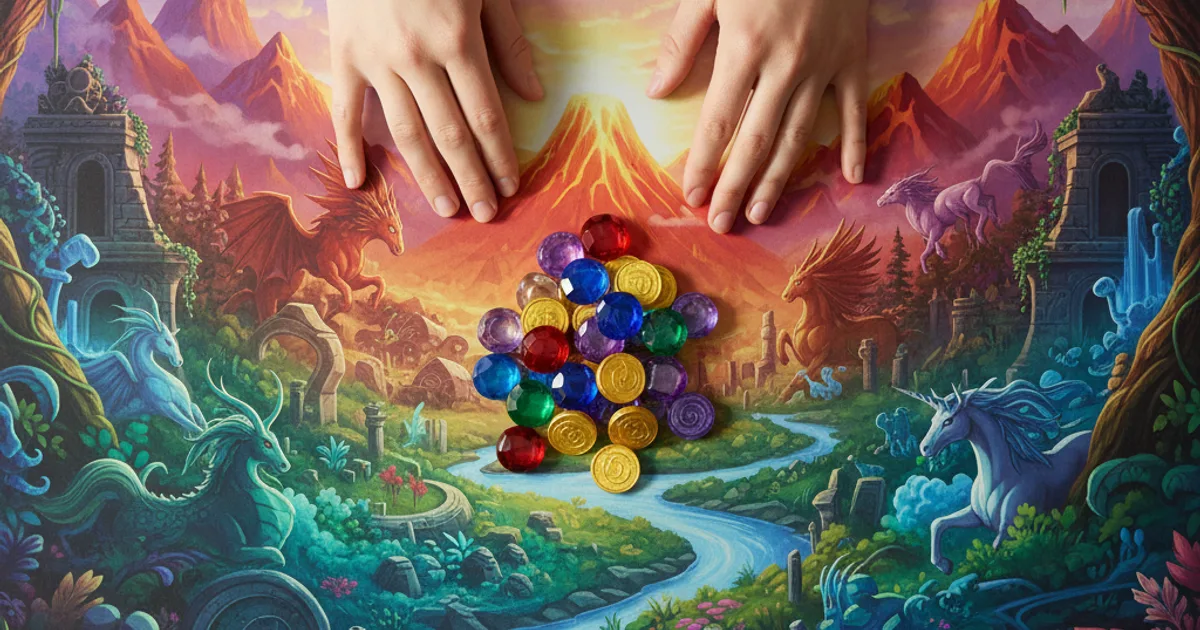
There is a moment, usually about four turns into your first game with the Red/Blue trial deck, where you look at a little pile of counters next to your play mat and realise nobody has ever told you what they are.
You know how you got them. A Pal came down, its text said Get 2 Material@, you took two of something. You know roughly what they are for, because a Structure over there wants you to consume one. What you do not know is the part that matters: whether they go away at end of turn, whether there is a limit, whether your opponent can see them, and whether the two you are sitting on are worth anything at all in the deck you happen to be playing.
Our own glossary is not much help, and it is honest about it. Under Resource it says: "A tracked quantity you hold — Material and Ingredient. Cards consume them. Resources are not how card costs are paid; souls are." Accurate, useful as far as it goes, and it goes about one sentence.
So this piece goes and gets the rest. Everything below comes out of the Palworld OFFICIAL CARD GAME Comprehensive Rules ver. 1.00, the publisher's own Rule/Q&A, and the printed text of every card in the pool. Where the rulebook is quiet, this piece says it is quiet rather than filling the silence.
Two resources, and a rulebook section almost nobody reads
Resources get their own home in the rules, at section 3.3, tucked between life and zones. It is short, and it does most of the work.
The rulebook starts by saying what a resource is. At 3.3.1, each player has "resource information," and 3.3.1.1 defines that as "the resource name and the number of each resource." Then 3.3.1.2.1 names them, and the phrasing is worth a second look:
In the current game, each player may hold the following resources. ⬥ Material ⬥ Ingredient
"In the current game" is doing something deliberate there. Two is today's number, not the game's number. The framework is built to hold more, and a later set can add a third without touching a rule. Treat "there are two resources" the way you would treat a card pool figure, because that is what it is.
The publisher's Q&A adds the plainest definition anyone has written. Entry 14 asks, flatly, "What are 【Material】 and 【Ingredient】?" The answer:
These are information of a player. 【Material】 and 【Ingredient】 by themselves do not hold any special abilities, but they may be gained or consumed by card abilities.
Information of a player. Not cards, not tokens, not anything in a zone. They sit on the same shelf as your life total and your damage taken, which is exactly where the rulebook files them. That has consequences, and we will get to all of them.
One piece of housekeeping first. Card text on our catalogue prints Get 3 Ingredient@, and the @ is not a typo we failed to clean up. It is the marker for an icon in the printed text, and it shows up after Damage@, Power@ and Strike@ in exactly the same way. Read it as "and here there is a little picture."
They start at zero, and no phase ever gives you any
Setup handles resources in one line. Rule 6.2.1.10: "Each player sets their resources (3.3) to 0." Our own rules page folds it into the same step: "Both players set life to 10, damage taken to 0, and all resources to 0."
Now hold that next to what the turn does. A turn runs five phases in fixed order, and the rulebook gives each one its own subsection: stand (7.2), draw (7.3), soul (7.4), main (7.5), end (7.6). The soul phase has an entire rule devoted to handing you income, 7.4.2.1, setting the number of souls you gain each turn at 2.
There is no resource phase. There is no clause anywhere in section 7 that gives a player a Material or an Ingredient. Souls arrive on a schedule; resources arrive only because a card said so. Q&A entry 14 says the same thing from the other end: they "may be gained or consumed by card abilities," and card abilities are the whole list.
That is the first real strategic fact about this system, and it is a big one. Your soul curve is fixed before you shuffle. Your resource curve is whatever you drafted into your deck, and if you drew none of it, your resource curve is a flat line at zero for the entire game.

They never expire, which is the whole trick
Here is where resources stop resembling souls and start being genuinely interesting.
Go and read the end phase. Rule 7.6.3 wipes the damage off every Pal and Structure on both boards. Rule 7.6.4 invalidates every effect with a duration of "until end of turn" or "during turn." That is the housekeeping list, and it is complete. Resources are not on it. Nothing in section 3.3 gives them an expiry either.
So they carry. All of them, indefinitely, from turn one to the end of the game.
Compare that with souls, which look generous and are not. Souls stand back up every stand phase, so an unspent soul is not saved, it is simply a soul you did not use. Our rules page puts the consequence well: because souls come from a separate deck, "your total economy across a game is bounded and known in advance."
Resources are the opposite in every direction. They are unbounded, unscheduled, and they wait. Rule 3.3.3 says "The number of resources owned has to be 0 or more," and 3.3.3.1 explains the floor: fall below zero and it becomes zero instead. That is a floor and nothing else. Search the rulebook for a ceiling on Material or Ingredient and you will not find one, because there is not one.
Which reframes what these things actually are. A Material is not a fast resource. It is a note to yourself, redeemable later, that survives everything the end phase does. The two Materials you took on turn two are still there on turn nine, worth the same as the day you got them.
Rule 3.3.4 closes the section by making them public: resources "are public information, and both players can confirm each other's resource values at any time." You cannot bluff a stockpile, and you cannot hide one. If you are holding three Ingredients, your opponent is entitled to know it and should be playing around it.
Spending: always a cost, never an effect
The rulebook defines exactly one verb for getting rid of a resource. Rule 5.13.1:
When instructed to "consume" a specified amount of a specific resource (3.3), that player reduces the specific resource they own by the specified amount.
Where that word appears on cards is more revealing than the definition. Across the whole pool, "Consume" is printed 15 times on 14 cards, and every single one of those 15 sits inside the square brackets at the front of an ability. Rule 10.4.1 is what makes those brackets meaningful: actions enclosed in [] at the beginning of the text "are known as the cost of that ability."
So resources are never something a card does to you. They are only ever something you pay. No card in the pool spends a resource as part of its effect, and no card gives you one as part of a cost. The two directions are cleanly separated, which is tidier design than most games manage in a first set.
Three rules govern the paying, and all three bite in real games.
You cannot pay part of a cost. Rule 10.4.2.2: "If the whole cost or part thereof cannot be paid, no part of the cost to play this ability is paid. You may not pay for only part(s) of the cost." Rule 3.3.3.2 says the resource half of that directly: if you are required to consume a resource "and you own fewer than the required number for that resource, the consumption cannot be performed."
This matters most on the cards with compound costs. Breeding Farm (EBP01-063) asks for [Consume 2 Ingredient@, assign 2 Pals] to deploy a Pal from hand. One Ingredient short and the whole thing is off. You do not get to assign the Pals anyway, and you do not get to consume the one you have.
Costs execute in printed order. Rule 10.4.2.1: multiple actions in a cost run "starting with the action closest to the beginning of the text." On Mounted Machine Gun (EBP01-015), [Consume X Material@, assign 1 Pal], the Materials go before the Pal rests.
A value naming a resource means how many you own. Rule 3.3.2.1: "If a value refers to a resource name, it refers to the number of that particular resource you own." Yours, not the total on the table.
The X question, answered by the publisher
Three cards in the pool print an X-shaped resource cost: Mounted Machine Gun (EBP01-015), Primitive Furnace (EBP01-016) and Cola Vending Machine (EBP01-064).
You would think the rulebook settles what X is, and it half does, in a way that would surprise you. Rule 10.6.2.2.2 says that if a value is written as X "and the way to determine X is not outlined in that text, the value of that X is regarded as 1." Read strictly, that would make Mounted Machine Gun a card that deals 500 damage once, for one Material, forever. Rule 10.6.2.3 pulls the other way, having the player determine and pay the cost when they play the ability.
The publisher resolved it in the Q&A rather than in the rulebook. Entry 35 asks whether an ability stating "Consume X [resources]" lets you choose 0. The answer is one word plus a comma: "Yes, you can."
You pick X. Zero is a legal pick.
That last part is not trivia on one of the three. Read Cola Vending Machine's text with X set to 0. The cost becomes [Consume 0 Ingredient@, assign 1 Pal], and the effect still reads "Choose 1 soul, and stand it," before it gets to the "up to 3 times of X" part that zero switches off. Assign a Pal, spend nothing, stand a soul. Whether that trade is worth a Pal's turn is a decision for the board in front of you, but the card allows it, and the ruling is what makes that readable rather than arguable.
While we are on official answers, two more are worth carrying to a table. Entry 56 confirms that when you consume 2 Materials on Mounted Machine Gun, the two instances of "Choose 1 Pal, and deal 500 damage" may pick the same Pal twice, so it is a 1000-damage single-target burn if you want it to be. And entry 77 handles a piece of Digtoise's Headband (EBP01-068) that reads like a trap: you may point it at an opponent's Digtoise, and you still collect the resources. The ruling is careful to add that their Pal still gets the +200 power, so the resources are not free, they are bought with a buff handed to the other side of the table.
The ledger: who makes it, who spends it
Now the pool. Reading the printed text of every card on the publisher's card list on 8 September 2026 gives 148 distinct main-deck-legal cards, once parallel rarities and the promo reprints are folded into their originals. Of those, 32 cards touch a resource in any way.
Split by resource, the shape of the thing appears immediately.
| Sources | Sinks | |
|---|---|---|
| Material | 11 | 5 |
| Ingredient | 11 | 9 |
Those columns overlap rather than add up to 32: two cards make either resource and so appear in both source columns, three cards both make and spend the same resource, and one card does neither, which we will come to. Counted once each, that is 20 sources and 14 sinks.
Eleven ways to make Material and five things to do with it. That is not a rounding error, it is a design decision, and it tells you what Material is for. Material is a resource you accumulate faster than you can spend, which is survivable precisely because of the no-expiry rule from earlier. Ingredient is close to balanced, and behaves much more like a currency.
Then look at colour, which is where it gets strict.
Every Material sink in the game is Red. All five: Reptyro – Ore Gorger (EBP01-005), Mounted Machine Gun, Primitive Furnace, Mossanda Lux – Vanguard Captain (ETD01-006) and Weapon Workbench (ETD01-009).
Every Ingredient sink in the game is Green. All nine, from Feed Box (EBP01-065) at two souls up to Lyleen – Blessing of the Goddess (EBP01-049) at seven.
Sources bend that line, but only slightly. Material's eleven sources are eight Red cards, one Colorless (Ribbuny – Little Princess (ETD01-024)), and two Green ones. Ingredient's eleven are ten Green and one Colorless (Chikipi – My First Pal (ETD02-024)). The two Green cards on the Material list are the same two cards both times: Ranch (EBP01-066) and Digtoise's Headband, the only cards in the pool that offer a choice of resource.
Which produces the sharpest practical note in this article. If you are playing mono-Green and you take Material off Ranch, you have taken a resource with zero outlets in your colour. The choice on that card is not a choice unless Red is in your deck. Point it at Ingredient and move on.
Not one Blue card in the pool makes or spends either resource. Purple has exactly one card in the whole system, and it is playing for the other team. Zoe's Strategy (EBP01-095) offers, as one of three modes, choosing "up to 5 of your opponent's Material and/or Ingredient in total," which that opponent then loses. It is the only resource removal printed, and it is the reason a very large stockpile is a target rather than a fortress. Worth noting that the card says "loses," not "consumes," and the rulebook defines the second word but not the first.
Four ways a card hands you a resource
The sources fall into recognisable shapes, and knowing the shapes is most of knowing how to build.
The engine. Four cards share one template almost word for word: [Assign 1 Pal] Get 3 <resource>, and draw 1 card. Those are Stone Pit (ETD01-008) at one soul, Primitive Furnace at two, Berry Plantation (ETD02-008) at one, and Ranch at two, which offers the choice of resource. Cheap Structures that turn a Pal's turn into three resources and a card.
The cost there deserves its name. Our rules page puts it plainly: "Assigning rests a standing Pal — a Pal that is already resting cannot be assigned, and an assigned Pal is not available to attack or block until it stands again," and calls it "the trade the Structure economy runs on: board presence now, or the Structure's output instead." Rule 5.17.1.1 is the hard version of the first half: a resting Pal cannot be assigned at all.
The burst. A Pal arrives and pays for itself. Flambelle – Scorching Tears (EBP01-012) brings two Material on deploy; Flopie – Snack Lover (ETD02-003) two Ingredient; Dumud – Mellow Bounty (EBP01-057) two Ingredient; Beegarde – Knight of the Flower Garden (EBP01-061) one. No Pal has to rest for these, which is what separates them from the engine.
The estate. Three cards pay out when they die: Ribbuny and Chikipi for one, and Mammorest – Roar of the Wilds (ETD02-007) for three. Given that resources never expire, a death trigger is a genuinely reasonable place to put resource income. The card was going to die anyway; the Ingredient it leaves behind is still spendable eleven turns later.
The consolation. Two Events hand you resources for failing to find what you were looking for. Treasure Chest Found! (EBP01-024) digs five deep for a Red Structure or Gear, and gives three Material if you take nothing. Found an Egg! (EBP01-071) does the same for a Pal and three Ingredient. Because the payout is conditional on choosing zero cards, these are the rare cards where whiffing has a floor.
The remaining odds and ends are worth a line each. Flame Cauldron (EBP01-017) drips one Material every time a Red Pal of yours is deployed. It is the only source in the pool that pays repeatedly without ever asking you to rest, spend or lose anything, which makes it the closest thing the game has to actual resource income. Stone Pickaxe (EBP01-022) and Farming Hat (EBP01-069) are the Gear version of the same idea: rest the Gear, buff a Pal, and collect one Material or one Ingredient respectively on the way past.
The work-suitability trap, which is not the trap you think
Structures print a work suitability the same way Pals do, and it is easy to assume the Structure's mark is a lock: that a Kindling Structure demands a Kindling Pal.
Nothing we can find says that. Rule 2.5.1 defines work suitability as indicating "the type of work that this card is suitable for," full stop, for any card that has one. Rule 5.17, the assign rule, has no work-type check in it at all. And every resource Structure in the pool that asks for an assignment asks for it in the bare form, "assign 1 Pal" or "assign 2 Pals," with no work type attached to the request. Our own glossary is careful in the same direction: Work Suitability is "the kind of work a Pal is suited to," and Assign is "to rest a standing Pal in order to put it to work on a Structure."
What a Structure's work suitability actually does is act as a tag other cards read. Rule 2.5.2 sets that up: a name in corner brackets 「like this」 in an ability's text refers to the matching work suitability. Exactly three cards in the pool read such a tag, and all three name the same one, 「Farming」:
- Mau Cryst – Harbinger of Riches (EBP01-035), Blue, draws a card when assigned to a Farming Structure.
- Dumud – Mellow Bounty, Green, adds a rested soul when assigned to a Farming Structure.
- Beegarde – Knight of the Flower Garden, Green, gets +500 power on deploy if you have a Farming Structure at all.
And there are exactly two Farming Structures in the game: Ranch and Breeding Farm, both Green, both cheap. So a five-card subtheme, entirely contained, is the only place a Structure's work type currently does anything. Mau Cryst is the tell: it is Blue, it touches no resource, and the only reason it would ever look at Ranch is that tag.
If a later set turns work suitability into an assignment restriction, this section is the one that ages. Everything else here is rulebook.
What to actually do with all this
Six things worth carrying into a game.
- Nothing gives you resources except your own cards. No phase, no rule, no consolation for a bad draw. A sink you drew without a source is a card that does nothing, so count them against each other while you are building rather than while you are losing.
- Resources keep. They survive the end phase, they have no ceiling, and they are worth the same on turn nine as on turn two. Taking three Material you cannot use yet is not waste, it is storage.
- Match your sinks to your colour before anything else. Every Material sink is Red. Every Ingredient sink is Green. Ranch and Digtoise's Headband are the only cards that let you choose, and the choice is only real in a two-colour deck.
- Count the whole cost, not the resource half. A compound cost is all-or-nothing. Being one Ingredient short of Breeding Farm does not get you a discount, it gets you nothing.
- X is yours, and zero is allowed. Officially. It makes Cola Vending Machine a different card than it looks.
- Your pile is public and there is exactly one card that attacks it. Play as though your opponent knows your resource count, because the rules say they do, and remember that Zoe's Strategy exists before you bank five of anything.
Sources and method
The rules quoted throughout are the Palworld OFFICIAL CARD GAME Comprehensive Rules ver. 1.00, last updated 30 July 2026, published as a PDF on the game's official site. Clause numbers are cited so you can check every one of them. Our rules and glossary pages are our own plain-English transcription of that document, and where this article quotes them it says so.
The four rulings come from the publisher's Rule/Q&A, which held 97 entries when we read it on 8 September 2026. Exactly four of those mention Material or Ingredient, all registered 30 July 2026, and all four are quoted or summarised above.
Card text and every count come from the publisher's card list, read the same day: 256 rows, reducing to 148 distinct main-deck-legal cards once parallel rarities and promo reprints fold into their originals. That 148 is the denominator here, and the 32 resource cards were found by reading printed card text, not by trusting the Q&A's own card tags. Those tags are looser than they look: ruling 14 is attached to 48 printings, and the list includes Gumoss – Dreamy Seedling (ETD02-002), a Pal with no card text at all, while omitting Stone Pit and Flopie, which both print the wording. Card links go to our own catalogue.
One gap is left open on purpose. The rulebook's section 5 walks through the game's specific actions one at a time and defines Consume among them, at 5.13. "Get" is not there, even though it is the word printed on all 20 resource sources. Nor is "loses," the word Zoe's Strategy uses. Q&A entry 14 supplies the meaning the rulebook never wrote down. Until a ver. 1.01 says otherwise, that Q&A answer is the definition, and this article does not invent a better one.
No win rates and no play percentages appear above, deliberately. This is a piece about a system, and it should still be correct after the next set lands. The only figures a new set will move are the pool counts, and those are stated with the date they were read.