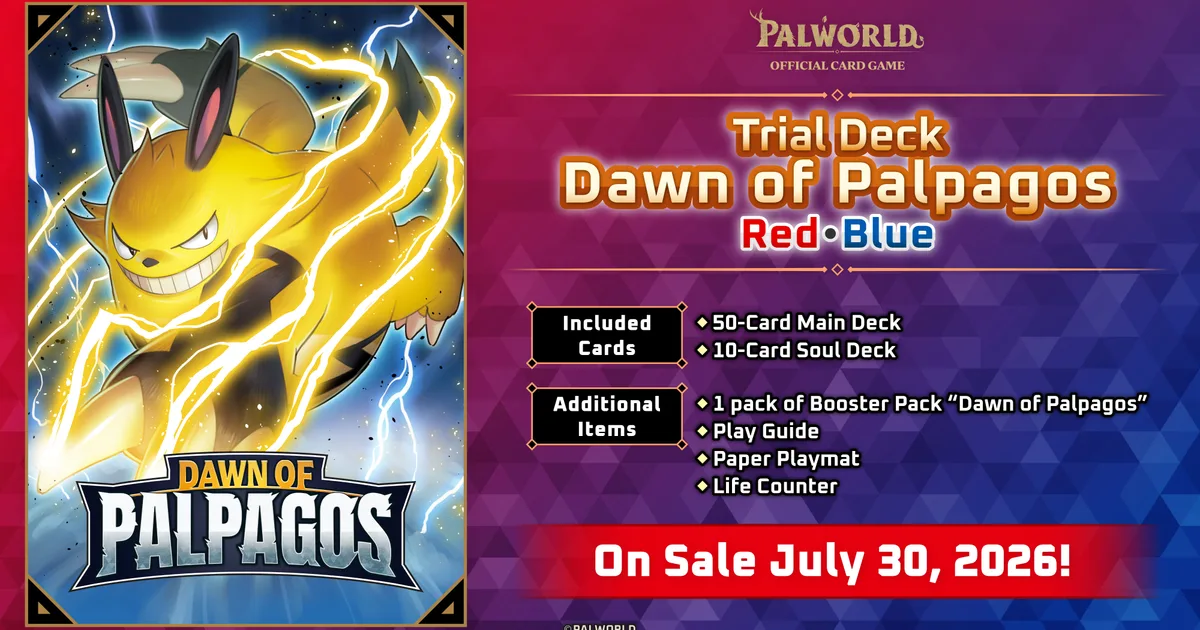
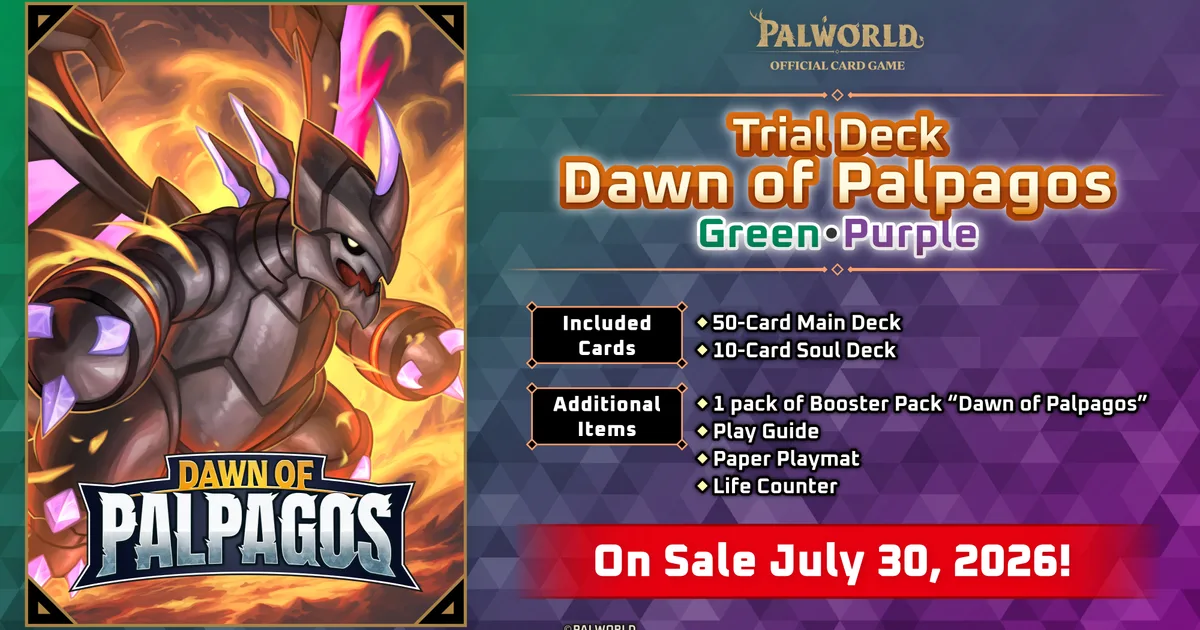
Trial decks are usually a tutorial with a price tag. You buy one, you learn where the cards go, and then you never think about it again because everything inside it is a worse version of something in the booster.
That is not what happened here. The Green・Purple deck contains the single most-played card in the Palworld TCG right now, the cheapest Interrupt Pal in the game, and the only three cards in the entire legal pool that carry Stealth. It also contains four Pals with no card text whatsoever, and one Lucky Pal whose best ability kills thirteen of the deck's own creatures. Both of those things are true at once, which is what makes it worth going through card by card.
What is actually in the box
The publisher's product page lists a 60-card set (50 main deck, 10 soul deck), a paper playmat and play guide, a life counter, a material and ingredient counter, and one sealed pack of Booster Pack Dawn of Palpagos. One card in the main deck is replaced by a parallel-rarity printing, either a Trial Deck Super Rare (TSR) or a Trial Deck Super Parallel (TSP). Released 30 July 2026, same day as everything else in the game.
What the product page does not print is the decklist. So here it is, taken from our own catalogue entry for the deck, which the platform ingested from the physical product and which checks out card-for-card against the publisher's card list:
| Copies | Card | Number | Cost |
|---|---|---|---|
| 2 | Berry Plantation | ETD02-008 | 1 |
| 2 | Gumoss – Dreamy Seedling | ETD02-002 | 2 |
| 2 | Cattiva – My First Pal | ETD02-023 | 2 |
| 2 | Chikipi – My First Pal | ETD02-024 | 2 |
| 3 | Hoocrates – Embodiment of Wisdom | ETD02-013 | 2 |
| 2 | Hanging Trap | ETD02-019 | 2 |
| 2 | Stone Blast | ETD02-011 | 2 |
| 2 | Leezpunk – Treasure Bandit | ETD02-014 | 3 |
| 2 | Flopie – Snack Lover | ETD02-003 | 3 |
| 2 | Campfire | ETD02-009 | 3 |
| 2 | Dinossom – Radiant Fragrance | ETD02-004 | 4 |
| 2 | Cawgnito – Looming Shadow | ETD02-015 | 4 |
| 2 | Cawgnito Hat | ETD02-020 | 4 |
| 2 | Strike from the Darkness | ETD02-021 | 4 |
| 2 | Mossanda – Guard Captain | ETD02-001 | 5 |
| 2 | Incineram – Lurking Stalker | ETD02-016 | 5 |
| 3 | Eikthyrdeer Terra – Guardian of Nature | ETD02-005 | 6 |
| 2 | Blazehowl Noct – Darkflame Defender | ETD02-017 | 6 |
| 2 | Refined Metal Spear | ETD02-010 | 6 |
| 2 | ★ Broncherry – Brimming Adoration | ETD02-006 | 7 |
| 2 | ★ Felbat – Lifestealer | ETD02-018 | 7 |
| 2 | Medical Supplies | ETD02-022 | 7 |
| 2 | ★ Astegon – Aegis Wyvern of Death | ETD02-012 | 8 |
| 2 | ★ Mammorest – Roar of the Wilds | ETD02-007 | 8 |
★ = Lucky Pal. Soul deck: 10 × Soul (ESOUL-001).
That is 34 Pals, six Structures, six Events and four Gear. Twenty-three Green cards, 23 Purple, four Colorless, and exactly eight Lucky Pals, which is the legal maximum. Every card in the box appears at least twice, so nothing here is a one-of you can't build around. The curve is bottom-heavy in a slightly odd way: thirteen cards at two souls, then a dip, then ten cards at seven or more.
How we judged this
Two separate things, kept separate on purpose.
The judgements are read off card text and the rest of the legal pool. When this piece says a card is strong or weak, the argument is what the card does compared with what else you could be playing at that cost in that colour. Card text and legality come from the publisher's own card list; the pool at the time of writing is BP01 Dawn of Palpagos, both trial decks and the 2026 PR promos.
The play rates are a popularity count, and nothing more. They come from 760 complete public decklists (main deck exactly 50, soul deck exactly 10) on the community deck builder at palworldtcg.gg, pulled on 10 August 2026 out of 780 public decks in total. That is what people are choosing to build. It is not a win rate and it is not field share, because neither exists yet: the publisher's own Deck Recipe page still prints "No entries found" under both Featured Decks and Tournament Decks. Where a play rate appears below, it is context beside an argument, not the argument.
For scale: 522 of those 760 decks contain at least one card from this trial deck. Green/Purple is the third most common colour pairing in the sample, at 118 decks, behind Blue/Red at 179 and Blue/Purple at 143.
The five that made the format
Strike from the Darkness (ETD02-021). Four souls, choose one Pal, put it in the graveyard. No cost cap, no colour requirement, no "if it is night", no "choose up to". It is the only card in the legal pool that answers anything for a flat price. Dark Cannon (EBP01-096) is cheaper and Quick, but stops at five cost, which means it does not touch Shadowbeak, Jormuntide, Vaelet, Lyleen Noct or either of this deck's own eight-drops. Zoe's Strategy (EBP01-095) can kill something, but only by butchering one of your own Pals first. Loupmoon and Helzephyr need night. Strike needs nothing.
It is the most-included main-deck card in the game right now, in 263 of the 760 lists, 34.6%, ahead of every card in the 100-card booster set. When people say the trial decks are still carrying this format, this is card they mean first.
Dinossom – Radiant Fragrance (ETD02-004). Interrupt is the mechanic that quietly decides Palworld TCG games: from your hand, during your opponent's attack, pay a soul and discard this card and the attack is nullified with no battle damage at all. There are nine Interrupt Pals in the pool, two of them reprinted again as 2026 promos. Dinossom is the cheapest, tied with Foxparks – A Toasty Hug (ETD01-004) from the other trial deck at four cost, and the two have identical bodies at 400 Power and 2 Strike. Green's only other Interrupt is Wumpo Botan (EBP01-062) at seven. If you are playing Green and you want to hold up an answer without wrecking your curve, this is the card, and there is no second option.
Blazehowl Noct – Darkflame Defender (ETD02-017). Purple's cheapest Interrupt, at six, and unlike Dinossom it is a real body when you cast it instead: 900 Power for six is fine, and Fire/Dark gives it reach into the night package. Pyrin Noct (EBP01-077) is the alternative, at seven.
Berry Plantation (ETD02-008). One soul. Assign a Pal, get three Ingredient and draw a card, once per turn. It is the exact Green counterpart of Stone Pit (ETD01-008) in the Red・Blue deck, and it is the cheapest Structure of its kind in Green by a full soul: Ranch (EBP01-066) does nearly the same job at two. The official Q&A confirms that once-per-turn is tracked per card rather than per name, so two copies means two draws a turn, which is why over half the decks that play it play four.
Leezpunk – Treasure Bandit (ETD02-014). Three souls, 200 Power, and when it dies your opponent discards a card. A two-Power body will die to almost anything, which is the point: it trades down on the board and up on cards. In 184 lists, 24.2%, and 61% of those run the full four.
The sleeper: Hanging Trap
Two souls. Assign a Pal, and exile any Pal on the table. One at a time, and it comes back if the Trap leaves your base.
Read the cost line again, because there isn't one. No cost cap, no colour, no condition. For two souls and a tapped Pal you can exile an eight-cost Lucky Pal that took your opponent five turns to reach. The nearest comparison in the pool is Viewing Cage (EBP01-092), which costs three, has to exile one of your own Pals as part of the price, and caps what it can take at the assigned Pal's cost plus two.
The catches are real. The Trap has 900 durability and dies to a medium attack, and when it goes, the Pal comes back deployed in the rest state, on the owner's side, which the official Q&A goes out of its way to define. It is a delay, not an answer. But it is a two-cost delay on literally anything, and 7.5% of decks play it. That gap between what the card says and how often it is played is the most interesting number in this deck.
Astegon eats your own board
Astegon – Aegis Wyvern of Death (ETD02-012) is the deck's showpiece, and it is genuinely powerful. Eight cost, Lucky Pal, 1200 Power, 3 Strike. On deploy, choose up to one Pal and give it −1000 Power until end of turn. On attack, choose all Pals with 300 Power or less and put them into the graveyard.
Two official rulings turn that into a combo and a trap at the same time.
The combo: a Pal is allowed to attack the turn it arrives. Deploy Astegon, drop a 1200-Power blocker to 200 with the deploy trigger, then attack, and the second trigger sweeps it away. The −1000 explicitly cannot kill on its own, but nothing stops the on-attack sweep from finishing the job the same turn.
The trap: "choose all" means all, and the publisher has ruled that you may not exclude any of them. The card even says so in brackets, Choose your Pals too. Count the Pals in this deck sitting at 300 Power or less and you get thirteen of the thirty-four: both Gumoss, both Cattiva, all three Hoocrates, both Chikipi, both Leezpunk and both Cawgnito. Attack with Astegon on a board you built out of this deck's own two-drops and you clear their side and yours.
That is not a printing error, it is a deckbuilding instruction. Astegon wants a board of Eikthyrdeer, Broncherry, Blazehowl Noct and Mossanda, none of which it can touch. It is also, in fairness, exactly why 113 decks run it and only 15% of those run four. It is a one-or-two-of, and the lists have worked that out.
Four blanks and two overpriced ones
There are thirteen Pals in the whole legal pool with no card text at all. Four of them are in this deck.
Mossanda – Guard Captain (ETD02-001), five cost, 900 Power, no ability. In 8 of 760 lists, and not one of those runs four copies. It is the least-played card in the set. For five souls Green can have Digtoise – Keen Needleback (EBP01-059) with a repeatable pump, or spend one more and get Eikthyrdeer with Taunt.
Incineram – Lurking Stalker (ETD02-016) is the same card in Purple. Same cost, same 900 Power, same blank text box, 16 lists.
Hoocrates (ETD02-013) and Gumoss – Dreamy Seedling (ETD02-002) are the two-cost versions, at 300 Power each. Purple's other two-drops are Depresso (EBP01-079), which reaches 700 at night, and Daedream – First Slumber (EBP01-080). Green's are Rushoar (EBP01-052), which gets +800 attacking a Structure, and Tanzee (EBP01-060), which pumps a Pal every time it is assigned. All four do something. Hoocrates is the deck's only three-of and it is in 23 lists, which tells you how quickly people worked that out.
Refined Metal Spear (ETD02-010) deserves its own line. Six souls for a Gear that rests to give a Pal +900 Power. Every other rest-and-pump Gear in the pool costs two to four and gives +200, which makes the Spear a considered attempt at a big-swing version. It does not work, because six souls is a turn where you could deploy Blazehowl Noct or Eikthyrdeer instead, and the Gear does nothing the turn it lands. 28 lists, and exactly one of them plays four.
Campfire (ETD02-009) is the near-miss. Three souls, consume two Ingredient and assign a Pal, gain a life and give all your Pals +1000 until end of turn. Repeatable, which Lily's Strategy (EBP01-070) is not. The problem is the assignment: you have to rest a standing Pal to pay for it, and a rested Pal cannot attack. So the team-wide pump costs you one of the attackers it was meant to pump. Lily's Strategy does the same thing for the same three souls, once, with no strings, and is in 166 decks to Campfire's 50.
The biggest Pal in the game, and nobody plays it
Mammorest – Roar of the Wilds (ETD02-007) has 2000 Power and 4 Strike. Both are the highest numbers printed on any Pal in the legal pool, above Jormuntide Ignis and Lyleen Noct at 1700. It is in 26 of 760 decks.
The argument against it is the Lucky cap. You may run eight Lucky Pals, total, and they do two jobs: they are cards you cast, and they are the cards that cancel damage when you turn them over off the top of your deck. Green already wants Lyleen – Blessing of the Goddess (EBP01-049) at seven, which is a whole engine, and Digtoise – Seismic Drillback (EBP01-050) at six. Every Mammorest is one of those you don't get. Its own death trigger, three Ingredient, only fires when it dies from the base, not from your hand or off the top of your deck as damage, so the copy that saves your life gives you nothing else.
Whether the field is right about this is a question nobody can answer yet, and we are not going to pretend otherwise. The card is enormous. It is also the fifth-least-played card in its own trial deck.
Three rulings that will catch you
All three are from the publisher's official Q&A, published 30 July 2026, and all three come up in games played with this deck straight out of the box.
- Interrupt only works from your hand. Dinossom and Blazehowl Noct sitting in your base cannot nullify anything. They are a Pal or an answer, never both at once, and you choose which when you play them.
- "When this card is put into the graveyard" only triggers from the base. Discarding Leezpunk to pay for an Interrupt does not make your opponent discard. Milling Chikipi as damage does not give you an Ingredient. Mammorest turned over off the top gives you nothing.
- Once per turn is per card, not per name. Two Berry Plantations means two activations a turn. Two Campfires, two Hanging Traps, same.
For what it is worth, the game's only errata so far, on 31 July, was for Ribbuny – Little Princess in the other trial deck. Nothing in ETD02 has been corrected.
What to change first
If you have this deck and one booster pack's worth of ambition, the Green/Purple lists in the sample converge hard on the same handful of additions. In the 118 Green/Purple decks we counted, Lyleen – Blessing of the Goddess appears in 82, Zoe's Strategy in 81, Lily's Strategy in 69 and Petallia – Sweet Blessings (EBP01-051) in 64. Those four sit alongside this deck's own core, which those same lists keep: Strike from the Darkness in 87 of 118, Dinossom in 80, Blazehowl Noct in 75, Berry Plantation in 71.
Read against the card text rather than the counts, the shape of the upgrade is straightforward. The six blanks and near-blanks (Mossanda, Incineram, both Hoocrates-tier two-drops, the Spear, and one Campfire) are the cards doing the least work, and Green and Purple's booster cards at those exact costs all do more. The cards worth going up to four copies of are the ones the box only gives you two of, which is most of what makes the deck good: Strike from the Darkness, Dinossom, Blazehowl Noct, Leezpunk and Berry Plantation. That is the honest reason a lot of people end up with two of these boxes.
One more note on Stealth, because it is the deck's one exclusive toy. All three Stealth cards in the entire legal pool are in here: Cawgnito, Felbat and Cawgnito Hat. Stealth means the card cannot be blocked, and blocking is the defender's one way to redirect an attack aimed at their face. Cawgnito Hat gives Stealth to anything for a turn, which includes handing it to Mammorest and its 4 Strike. That line is not popular (the Hat is in 32 decks) but it is real, and it exists nowhere else.
The verdict
As a first purchase it is a genuinely good one, and not for the usual trial-deck reason. The deck plays fine out of the box. It is a bit blank in the middle and its own best Lucky Pal wants a different board than the one it comes with, but nothing here is broken and the games work.
The reason to buy it is that five of its 24 cards are cards the format is actually built on, and one of them, Strike from the Darkness, is the most-played card in the game. You are not buying a tutorial with a couple of playables hidden in it. You are buying a playset-and-a-half of staples with a tutorial wrapped around them.
What we cannot tell you is whether the Green/Purple deck that grows out of this box beats anything, because no results exist to read. Shop tournaments have only just started, the Challengers Cup opens in September and Masters League 26/27 in November. Until standings exist, every judgement above is a reading of the cards and the pool, and we would rather say that than dress a card count up as a metagame.